Affordable home staging is often misunderstood. Many sellers assume it means doing the minimum — adding a few accessories, tidying up, or making small upgrades wherever possible. In reality, successful budget staging works the opposite way.
Learning how to stage a home on a budget is not about doing less. It is about doing the right things with precision.
Buyers form emotional impressions within seconds of entering a home. Long before they evaluate finishes or square footage, they decide whether the space feels calm, spacious, and move-in ready. Strategic staging shapes that reaction — creating polish and intention without unnecessary spending.
When every dollar matters, clarity matters more.
Why most homes need editing — not decorating
Occupied homes naturally accumulate layers over time. Furniture arrives in different eras, styles evolve, and rooms adapt to daily living rather than presentation. Individually, these choices make sense. Together, they often create visual friction.
Common issues include:
Furniture inherited or purchased years apart
Pieces sized for previous homes
Layouts designed for convenience rather than flow
Competing colours and materials
Rooms that feel crowded despite adequate square footage
Budget staging begins with editing. The objective is to refine what already exists — removing distractions and redistributing pieces so the home feels intentional instead of accumulated.
Often, the most impactful change is subtraction.
Start with what feels heavy
Nearly every room has one element that quietly compresses the space. Buyers may not consciously identify it, but they feel its effect immediately.
Typical visual “weight” comes from:
Oversized sectionals
Dark or undersized rugs
Bulky inherited furniture
Too many small décor items
Mismatched fabrics or wood tones
Outdated patterns
Removing or relocating a single heavy piece can dramatically improve flow and perceived size. Suddenly, the room breathes. Buyers understand the space more easily — and when buyers understand a room, they connect with it emotionally.
Space itself becomes part of the design.
The highest-impact upgrade most sellers overlook: the Rug
If there is one budget-friendly change that consistently transforms a room, it is replacing the rug.
Many homes have rugs that are too small, too dark, overly patterned, or visibly worn. These details subtly age a space even when furniture is perfectly functional.
It is often the fastest way to shift a room from everyday living to market-ready presentation without replacing major furniture.
Styling creates confidence, not clutter
Once the foundation is corrected, styling becomes the finishing layer. Buyers respond strongly to balance and scale, even if they cannot articulate why.
Large, well-placed artwork adds authority to a room. Coordinated accessories create visual relationships between materials and colours.
Thoughtful styling can:
Connect mismatched finishes
Soften dated elements
Introduce cohesion without renovation
Make older furniture feel curated rather than outdated
The goal is never more décor. The goal is intention.
How to stage a home on a budget without replacing everything
Budget staging succeeds through selectivity. Most rooms do not require wholesale replacement, only correction.
Focus on the piece that is:
Most worn
Poorly scaled
Stylistically dated
Visually dominant in a negative way
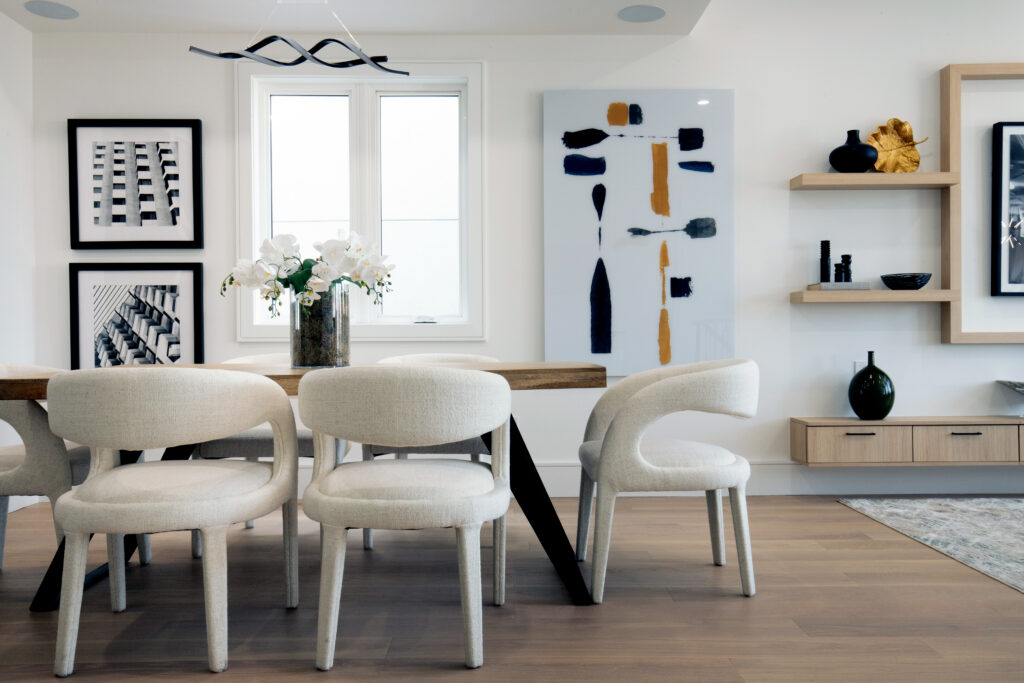
Replacing a single offender often recalibrates the entire space. New dining chairs can modernize an existing table. A new rug and toss cushions can lighten a heavy sofa. Nightstands moved from another room can elevate a primary bedroom instantly.
Strategic reallocation reduces rental costs and maximizes what the seller already owns.
Concentrate your budget where buyers feel it most
Not all rooms carry equal emotional weight. Buyers form lasting impressions in a few key spaces:
The living room
The primary bedroom
The dining room when prominently featured
When these rooms feel polished and cohesive, buyers subconsciously assume the rest of the home is equally well cared for. Secondary rooms can remain simpler without reducing overall impact.
Depth always outperforms distribution.
The biggest budget staging mistake: Dilution
The most common mistake sellers make is spreading the budget too thin. Small upgrades everywhere rarely create meaningful improvement anywhere.
Low-end furniture, minimal artwork, or incomplete staging sends an unintended signal: hesitation.
If a room is staged, it should feel resolved. Furniture must fit the scale, complement the architecture, and be styled intentionally. Buyers instantly recognize the difference between thoughtful composition and partial effort.
Concentration creates impact. Dilution weakens it.
Staging a vacant home without overspending
Vacant homes introduce a different challenge. The instinct is often to fill every room with inexpensive furniture so the home appears complete. Unfortunately, this approach frequently lowers perceived value.
When staging becomes noticeable, buyers stop seeing the home itself.
A more effective strategy is selective staging: execute one or two key rooms exceptionally well — typically the living room and primary bedroom — and leave secondary spaces empty.
Empty rooms feel neutral. Poor staging feels like a downgrade.
Discount staging packages can also be risky. Uniform or low-quality furnishings often signal cost-cutting rather than value.
Staging should elevate the home’s perception, never compete with it.
What smart budget staging really achieves
Effective budget staging is disciplined, not minimal. It focuses on:
Editing strategically
Removing visual weight
Reallocating existing furniture
Replacing selectively
Concentrating investment where emotion forms
Using rugs, art, and scale to create cohesion
Luxury is rarely about cost alone. More often, it comes from coordination — the quiet sense that everything belongs.
That feeling drives buyer confidence.
Final thought
If you want to stage a home affordably, focus on clarity:
Remove the offenders
Strengthen visual anchors
Concentrate impact in key rooms
Avoid spreading the budget too thin
Never stage poorly simply to fill space
When rooms feel intentional, buyers relax. And relaxed buyers make confident, decisive offers.
A next step
If you’re planning a staging and wondering whether to edit, replace, or leave things as they are, an objective staging consultation can provide clarity.

How to Stage a Home on a Budget
without making it look cheap or undermining value
by Carmen
Affordable home staging is often misunderstood. Many sellers assume it means doing the minimum — adding a few accessories, tidying up, or making small upgrades wherever possible. In reality, successful budget staging works the opposite way.
Learning how to stage a home on a budget is not about doing less.
It is about doing the right things with precision.
Buyers form emotional impressions within seconds of entering a home. Long before they evaluate finishes or square footage, they decide whether the space feels calm, spacious, and move-in ready. Strategic staging shapes that reaction — creating polish and intention without unnecessary spending.
When every dollar matters, clarity matters more.
Why most homes need editing — not decorating
Occupied homes naturally accumulate layers over time. Furniture arrives in different eras, styles evolve, and rooms adapt to daily living rather than presentation. Individually, these choices make sense. Together, they often create visual friction.
Common issues include:
Budget staging begins with editing. The objective is to refine what already exists — removing distractions and redistributing pieces so the home feels intentional instead of accumulated.
Often, the most impactful change is subtraction.
Start with what feels heavy
Nearly every room has one element that quietly compresses the space. Buyers may not consciously identify it, but they feel its effect immediately.
Typical visual “weight” comes from:
Removing or relocating a single heavy piece can dramatically improve flow and perceived size. Suddenly, the room breathes. Buyers understand the space more easily — and when buyers understand a room, they connect with it emotionally.
Space itself becomes part of the design.
The highest-impact upgrade most sellers overlook: the Rug
If there is one budget-friendly change that consistently transforms a room, it is replacing the rug.
Many homes have rugs that are too small, too dark, overly patterned, or visibly worn. These details subtly age a space even when furniture is perfectly functional.
A properly scaled, lighter rug can:
It is often the fastest way to shift a room from everyday living to market-ready presentation without replacing major furniture.
Styling creates confidence, not clutter
Once the foundation is corrected, styling becomes the finishing layer. Buyers respond strongly to balance and scale, even if they cannot articulate why.
Large, well-placed artwork adds authority to a room. Coordinated accessories create visual relationships between materials and colours.
Thoughtful styling can:
The goal is never more décor. The goal is intention.
How to stage a home on a budget without replacing everything
Budget staging succeeds through selectivity. Most rooms do not require wholesale replacement, only correction.
Focus on the piece that is:
Replacing a single offender often recalibrates the entire space. New dining chairs can modernize an existing table. A new rug and toss cushions can lighten a heavy sofa. Nightstands moved from another room can elevate a primary bedroom instantly.
Strategic reallocation reduces rental costs and maximizes what the seller already owns.
Concentrate your budget where buyers feel it most
Not all rooms carry equal emotional weight. Buyers form lasting impressions in a few key spaces:
When these rooms feel polished and cohesive, buyers subconsciously assume the rest of the home is equally well cared for. Secondary rooms can remain simpler without reducing overall impact.
Depth always outperforms distribution.
The biggest budget staging mistake: Dilution
The most common mistake sellers make is spreading the budget too thin. Small upgrades everywhere rarely create meaningful improvement anywhere.
Low-end furniture, minimal artwork, or incomplete staging sends an unintended signal: hesitation.
If a room is staged, it should feel resolved. Furniture must fit the scale, complement the architecture, and be styled intentionally. Buyers instantly recognize the difference between thoughtful composition and partial effort.
Concentration creates impact. Dilution weakens it.
Staging a vacant home without overspending
Vacant homes introduce a different challenge. The instinct is often to fill every room with inexpensive furniture so the home appears complete. Unfortunately, this approach frequently lowers perceived value.
When staging becomes noticeable, buyers stop seeing the home itself.
A more effective strategy is selective staging: execute one or two key rooms exceptionally well — typically the living room and primary bedroom — and leave secondary spaces empty.
Empty rooms feel neutral. Poor staging feels like a downgrade.
Discount staging packages can also be risky. Uniform or low-quality furnishings often signal cost-cutting rather than value.
Staging should elevate the home’s perception, never compete with it.
What smart budget staging really achieves
Effective budget staging is disciplined, not minimal. It focuses on:
Luxury is rarely about cost alone. More often, it comes from coordination — the quiet sense that everything belongs.
That feeling drives buyer confidence.
Final thought
If you want to stage a home affordably, focus on clarity:
When rooms feel intentional, buyers relax.
And relaxed buyers make confident, decisive offers.
A next step
If you’re planning a staging and wondering whether to edit, replace, or leave things as they are, an objective staging consultation can provide clarity.
Stage Right Rental’s complementary Concierge Service may be able to help!
Alternatively, if you’d like to enhance your DIY staging skills, you may want to take advantage of the workshops available at the Stage Right Academy Studio, offering you engaging, hands-on staging experience. •